
Moss Giants
Four huge, bright green figures have taken root in the forest on Örudden here in Söderlångvik. This is their permanent home where they’re becoming a part of the surrounding nature –hopefully real moss begins to grow on the big sculptures. The moss giants give off an air of mystery. Their origin is unknown: are they visitors from a parallel reality, or have they always been part of this world as we know it? The Moss Giants have become a unique attraction at Söderlångvik Manor.
“The moss children are independent, and don’t need the help of adults,” Simonsson says. The children form a community, a band of travellers. Each child has been given its own specific task, all equally significant for their coexistence. Some carry tools and transport equipment on their backs, others are accompanied by animals, hinting at a close relationship with the natural and non-human world. Sign language allows them to communicate silently with one another and with their surroundings. Their presence reflects the artworks’ underlying idea of a utopian world where humans, animals and other beings co-exist peacefully. Perhaps the moss giants could be understood as monuments of wonder, or guides to a more imaginative view of the world. Rather than proclaiming truths, they invite us to question, dream and imagine in the same fearless way that children do. “It is important to give space to ideas that at first glance seem absurd,” Simonsson explains.
The set of artworks is completed by the Song of the Moss Giants, a piece of music composed by Perttu Haapanen. During the summer months the giants open their lungs at sunrise, sing during the day at 12.20 and 15.20, and end the day by singing at sunset. What do giant children’s songs sound like and what do they sing about?
The Sculptures

BRINGER OF LIGHT
2022
Iron frame, polystyrene, fibreglass, nylon fibre, paint
(4,22 x 1,5 x 1,68 m)
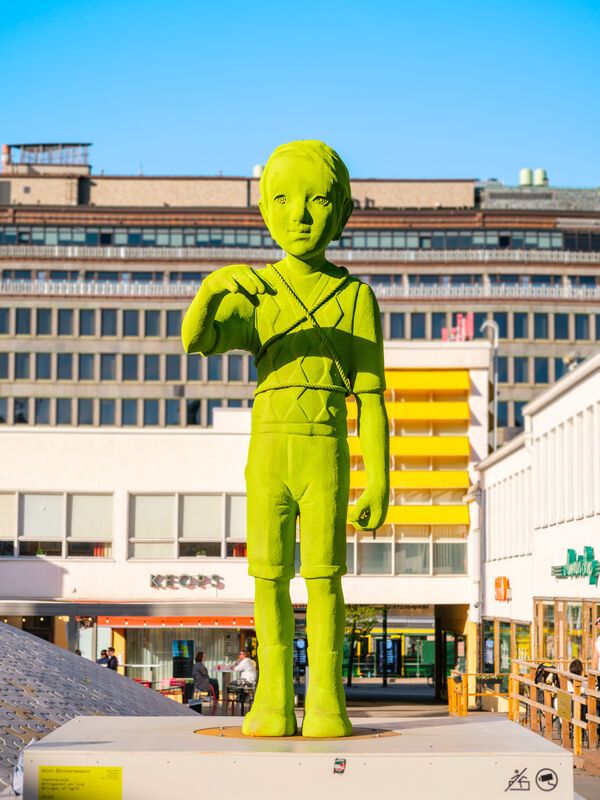
Bringer of Light is a giant with a lantern by his side and a lamp on his back. The mass-produced desk light and the shorts and vest of the figure are strikingly ordinary compared to this otherwise fantastical being. The figure stretches out an open palm facing down, fingers spread wide. This is the sign for lamp and light, but also for the very moment when a light is switched on. Like children, light is often seen as a symbol of hope, pointing towards the possibility for a brighter future. Perhaps it’s also the task of the Light bringer to shine a light on things that feel difficult to deal with.

FRIENDSHIP
2022
Iron frame, polystyrene, fibreglass, nylon fibre, paint
(3,04 x 2,14 x 2,06 m)
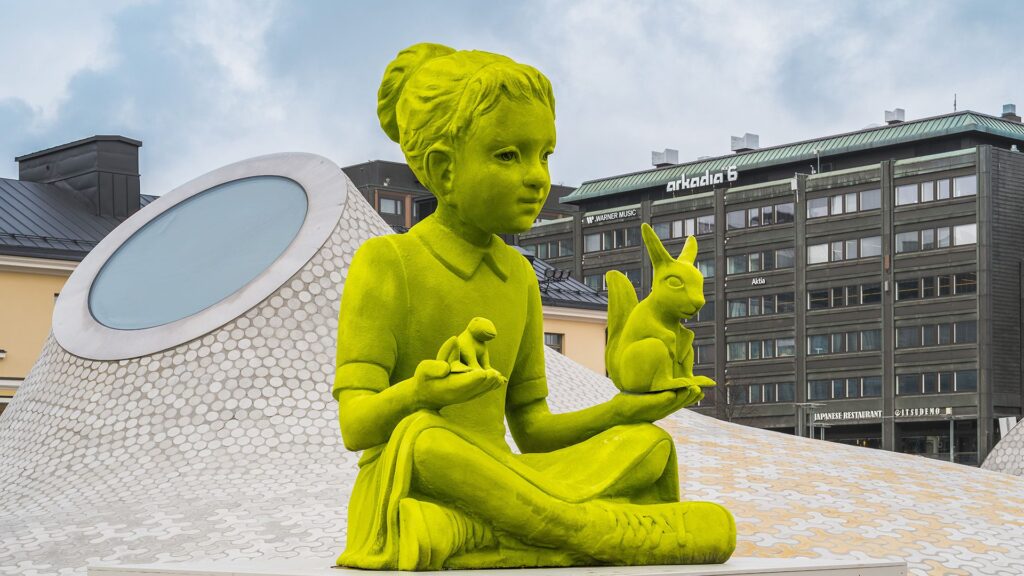
This giant child is peacefully seated by the small pond in the forest. Like an attentive listener, the being leans gently forward with an enigmatic smile. A frog and a squirrel have found their way into the open palms of the giant sitting cross-legged. A first glance would suggest a harmonious co-existence between the three creatures, yet the nature of their relationship is unclear. The sculpture invites us to reflect on the conditions under which friendship can arise and between whom.

WANDERER
2022
Iron frame, polystyrene, fibreglass, nylon fibre, paint
(4,16 x 1,24 x 2,08 m)
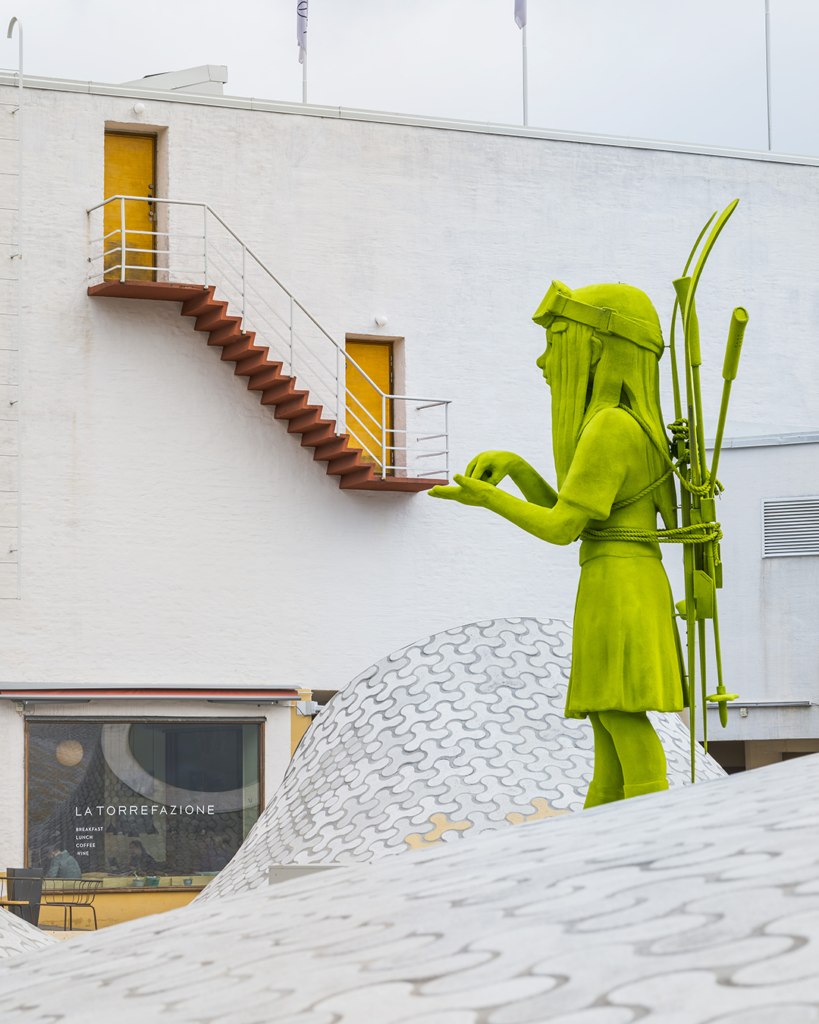
A wanderer with skis and poles has landed in midst of the woods, perhaps ready to chart unknown territories. The giant hands declare a mission – two fingers moving across the palm is the sign for walking, or hiking. As sign language is largely based on movement, its expressive power is directly linked to the body and to touch. Humans gain an understanding of the world largely through our sense of touch. Another way to explore the world is through travel. But travelling doesn’t always entail moving from one far-flung place to another. It can also be an act of introspection, digging deep into our memories and

COLLECTOR
2022
Iron frame, polystyrene, fibreglass, nylon fibre, paint
(3,64 x 1,7 x 2 m)
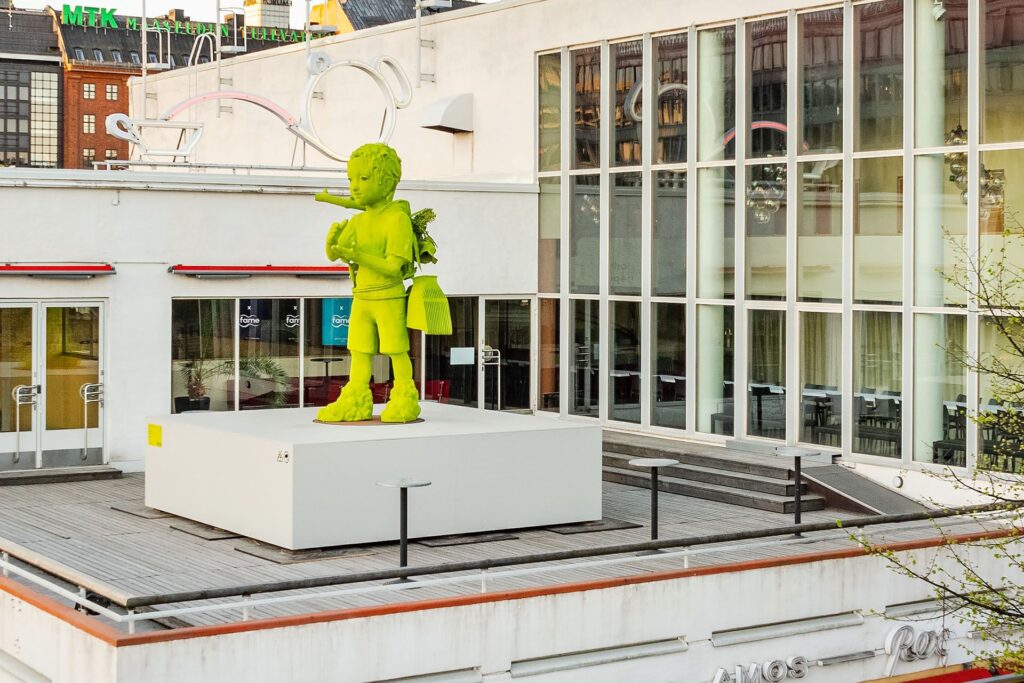
The giant Collector observes surrounding nature with alert eyes, perhaps searching for something worth collecting. The giant’s hands give a gentle impression, as if they were cupped around an invisible object. This is the sign for collecting in Finnish sign langue. As part of his artistic process, the artist Kim Simonsson uses objects found in his studio to design the individual equipment for each giant. This intuitive way of working is evident in the Collector’s equipment, which consists of a mishmash of different utensils and organic natural elements. What is worth collecting and saving for the future, and who gets to decide that? In an everchanging world, the previously useless can suddenly become an absolute necessity.
The Moss Giants’ Songs
By composer Perttu Haapanen
From the very beginning, Kim Simonsson had the idea of gibbon sounds, and the morning, day and evening songs of the giants, which would occur according to the rhythm of nature and the sun. First, I made different demos, from which these hooting sounds were then selected. The fact that the Moss Giants remain motionless in the forest and gradually turn mossy steered the idea away from the human-like sounds and towards a more nature-inspired one.
The songs of the giants fall somewhere between hooting of gibbons, birds’ song and choral singing of humans. The modified sounds of the gibbons are also combined with formants of the human voice, i.e. amplifications of the frequency ranges typical for different vowels. The harmonies and rhythms of the songs are from the human world, but I have retained a small amount of living imprecision and chance in them. The inspiration is not only the spontaneous singing of children, but also the freedom of birds singing together. The childlike quality is also reflected in the fact that the sounds are not the size of giants. The large vocal tracts are reflected more in the slowed-down and stretched-out nature of the sounds.
The Moss Giants’ songs are quite gentle and all four have their own voices. Each has a role to play in the songs. The Bringer of Light has the lowest vocals and provides the others with a harmonious base and support. Friendship is the peaceful support and unifier. The Wanderer and the Gatherer are the leaders of the songs and have the highest voices. The Gatherer in particular is very active in the daytime song. The Morning Song is calm and “awakening”. The daytime song is more active and playful. The evening song is more soothing towards the night.
Perttu Haapanen (b. 1972) is a Finnish composer specialising in art music. He lives in Helsinki and has studied composition at the Sibelius Academy, as well as electroacoustic music at the Parisian IRCAM institute. He is particularly interested in how voice and language relate to music.
The Moss Giants in Helsinki
The Giants were originally created for the French festival lille3000. On their way to Söderlångvik Manor, they made a temporary rest stop in the Lasipalatsi square in Helsinki in 2024.

Kim Simonsson
Sculptor Kim Simonsson (born 1974) lives and works in the artist village of Fiskars in Western Uusimaa. He is known for his open-minded storytelling and his profound knowledge of materials. Clay and ceramics form the foundation of his artistic practice, often combined with other materials such as glass, fibers, or everyday objects. Simonsson primarily sculpts animal and human figures, either in natural or oversized scale. With a sharp sense of contrast, he creates strange, fairy-tale-like worlds.
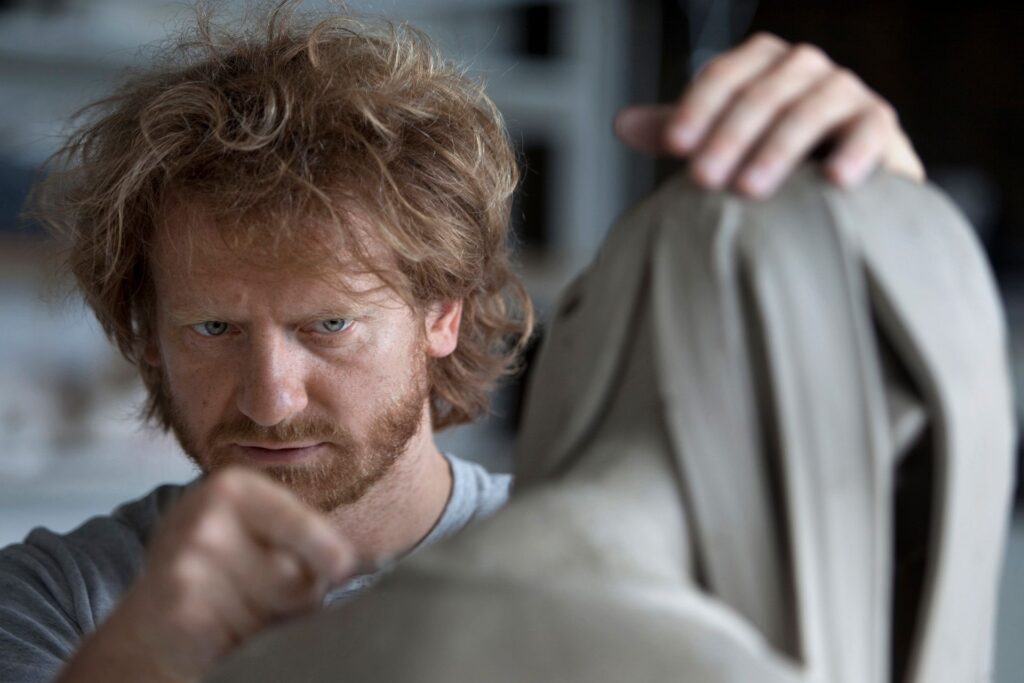
Simonsson’s artistic career began in the 1990s when he started his studies in the Department of Ceramics and Glass at the University of Art and Design Helsinki. Having long focused on drawing and painting, he quickly grew fond of working in three dimensions. Clay, so responsive to the touch, proved well suited to his artistic expression, which was strongly influenced by the visual storytelling of comics, especially Japanese anime. During his studies, he created life-sized porcelain dogs, fearless child characters, and other figures. These early works broke away from the abstract expression that dominated Finnish ceramic art until the early 2000s.
Since the 2010s, Simonsson has experimented with the so-called flocking technique, where surfaces are coated with nylon fibers. He encountered the method during an artist residency in Canada and continued experimenting in his studio in Fiskars. The moss-like texture characteristic of the series Moss Giants emerged by happy accident when Simonsson, for fun, covered a discarded sculpture, previously painted black, with neon-yellow fibers. The resulting bright green shade brought to mind the mystery of deep forests and their enigmatic creatures, laying the foundation for the childlike Moss Giants.
The theme of childhood has occupied Simonsson since the beginning of his career. His child figures navigate the borderland between innocence and alienation, often challenging cultural norms of desirable and undesirable behavior. The artist refers to them as anarchist children. More recently, Simonsson has also been influenced by his personal experiences as a parent. With one of his children, he communicates using sign language. The experience of discovering a new language is reflected in the Moss Giants, where sign language has become part of the sculptures’ unique world. In this way, his artistic practice continuously evolves in dialogue with the joys and challenges of everyday life.
Sign language
Sign languages are visual languages used by deaf, hard-of-hearing, and hearing individuals. They consist of various signs that combine hand movements, body posture, mouth movements, and facial expressions. Compared to spoken languages, sign languages are characterized by a certain silence. They highlight the richness of communication that can occur even without a physical voice.
There are an estimated 160 different sign languages in the world. Each sign language has its own rhythm, and many differ greatly from one another. Like spoken languages, sign languages include different dialects and idiomatic expressions, and factors such as place of residence and age can influence how someone signs. Nevertheless, sign languages share a strong visual expression that generally enables fluent communication between signers.
In Finland, two sign languages are used: Finland-Swedish Sign Language and Finnish Sign Language — the latter also used by Kim Simonsson’s Moss Giants. Read more about the giants’ sign language in the artwork descriptions!